

In the rapidly evolving landscape of urban planning, the simple presence of "green space" is no longer the gold standard. As we navigate 2026, researchers are shifting focus toward the lived experiences of city dwellers using the EMA method. By utilizing mobile technology to collect data in real-time, we can finally move past the "where" of urban parks and dive deep into the "how" how a park makes a person feel. The EMA method has emerged as the premier methodology for capturing these "micro-moments" of human-environment interaction.
"Nature is not a luxury, but a necessity of the human spirit." — Edward Abbey
Are you curious how specific park features can "cancel out" the psychological benefits of nature? How can the EMA method bridge the gap between architectural intent and human emotion? Why is a participant's subjective "first impression" more predictive of mood than tree counts? Leading scientists are now turning to the EMA method to turn thousands of GPS-verified data points into actionable insights for city planners.
The problem remains that for decades, urban "greenness" was measured by satellite imagery, which ignores the human element. Research by Schertz et al. (2025) highlights that hidden qualities are the true drivers of well-being, a discovery made possible by the EMA method. Without utilizing an EMA method, we are essentially guessing how residents interact with their local infrastructure.
As the Digital Marketing Specialist at ExpiWell, I have spent years collaborating with behavioral scientists to translate complex methodologies into accessible applications. My work involves analyzing studies that utilize the EMA method to solve the "recall bias" plague. By highlighting pioneers like Dr. Schertz and Dr. Meidenbauer, I aim to provide a roadmap for the future of social science research through the EMA method.
After reading this article, you will understand the critical role of the EMA method in modern research and how to leverage GPS-verified mobile surveys to ensure the highest level of data integrity.
Before diving into the research findings, it is essential to define the core concepts that drive this field:


We are thrilled to feature the innovative work of Dr. Kathryn Schertz (University of Michigan) and Dr. Kimberly Meidenbauer (Washington State University). Their study, "Identifying qualities and amenities associated with subjective cognitive restoration and improved affect in urban parks," exemplifies the cutting edge of environmental psychology. By adopting the EMA method, their team provides profound insights into creating more restorative urban spaces.
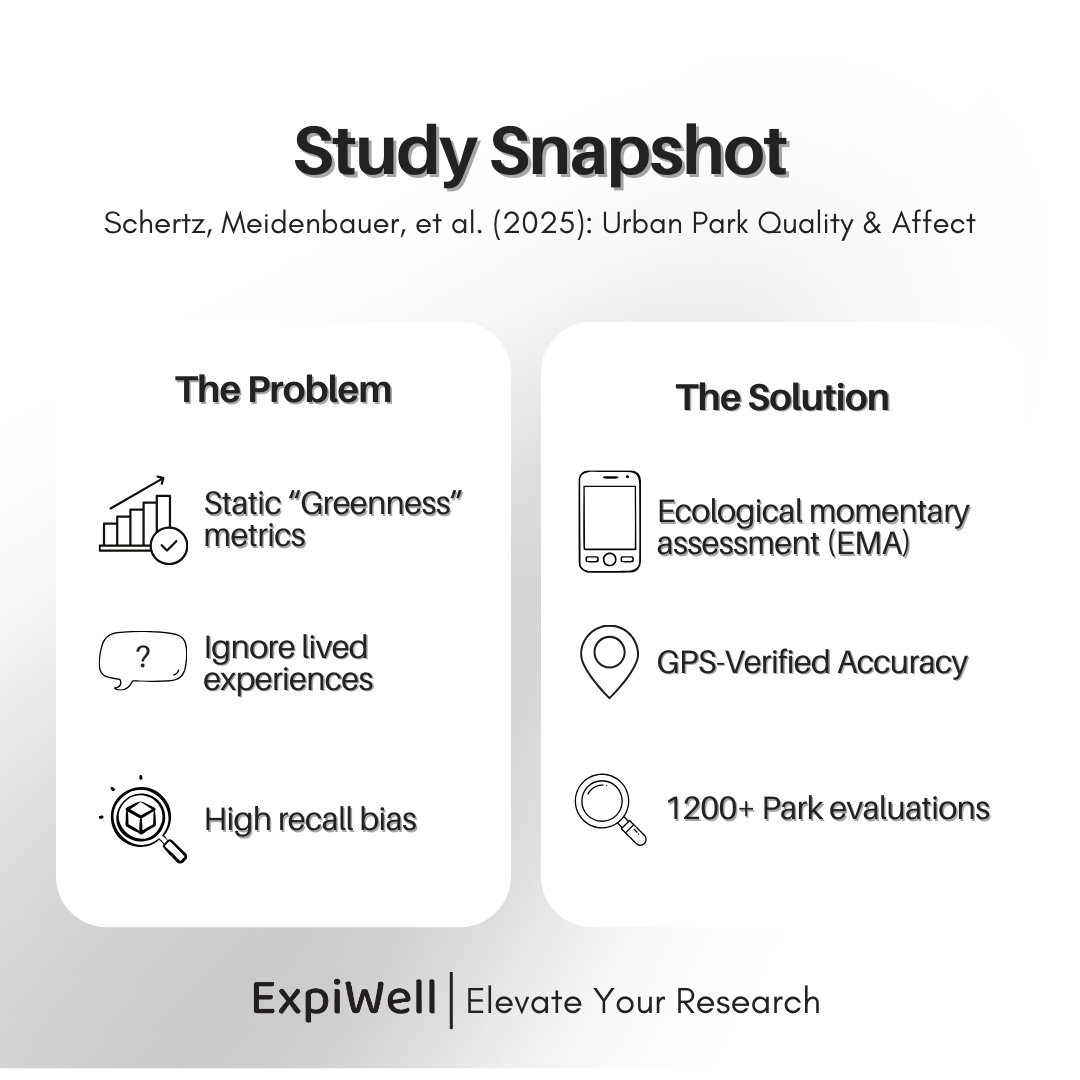
We recently sat down with the research team behind the groundbreaking study, "Identifying qualities and amenities associated with subjective cognitive restoration and improved affect in urban parks," to discuss how they used Ecological Momentary Assessment to redefine our understanding of urban nature.
Most research treats urban "green spaces" as a universal benefit. However, the team wanted to look past the mere presence of parks to investigate the specific qualities like safety and noise that actually drive well-being.
The Team: "We knew from prior work that the presence of a park in someone’s neighborhood doesn’t necessarily mean that they are visiting it. This project was a step in understanding what sort of features matter when people are deciding to visit a park and the psychological impacts of that visit."
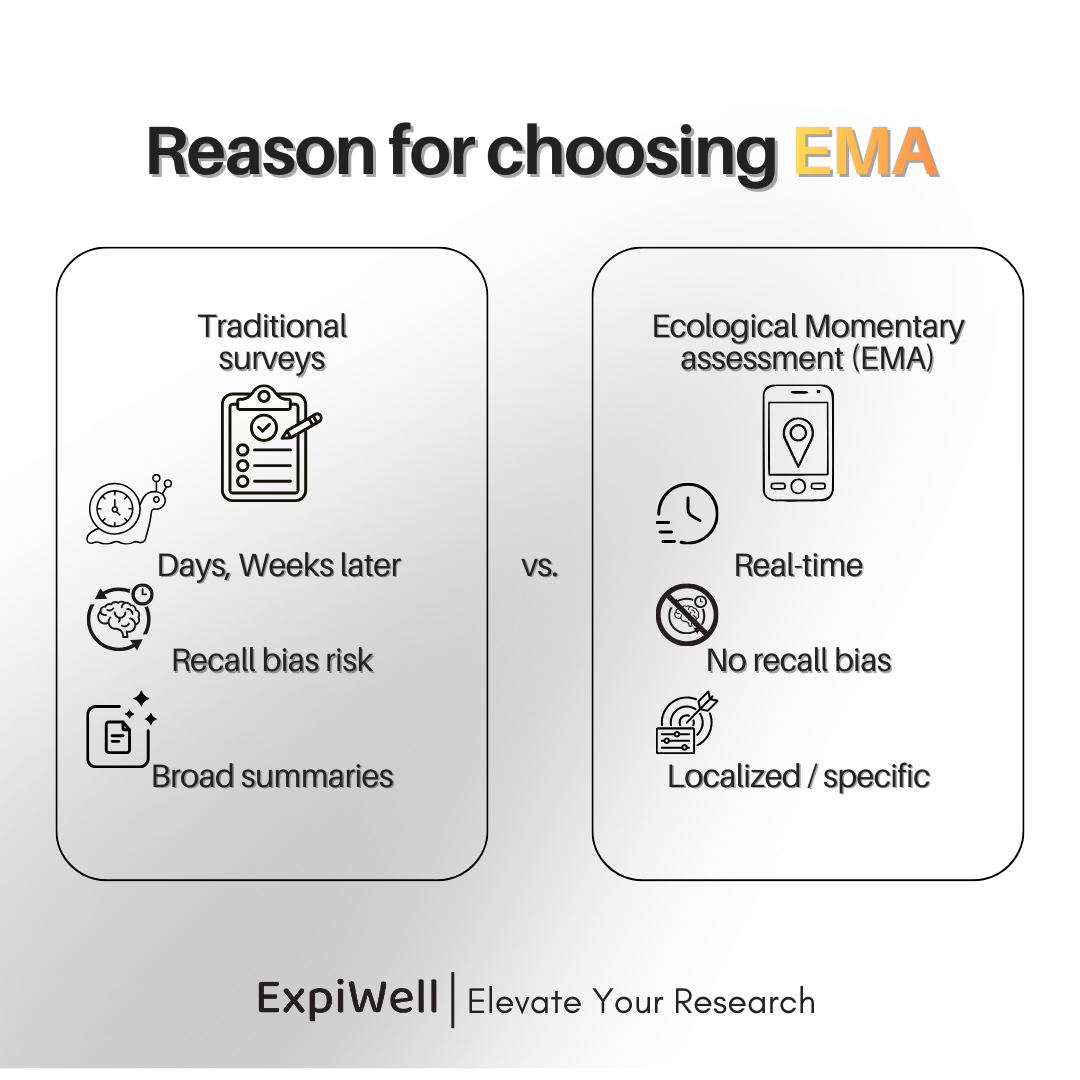
The study utilized the EMA method via the ExpiWell app to capture 1,234 unique park evaluations across 67 Chicago community areas.
One of the most striking results was that "Being Away" the feeling of mental detachment was the strongest predictor of restoration. This mental distance is hard to capture in a lab but becomes crystal clear through the EMA method.
The researchers found that naturalness benefits can be "cancelled out" by feeling unsafe or seeing a lack of maintenance.
"Cities can’t just have natural areas; they have to take care of them so that people feel comfortable enough to gain the psychological benefits."
One of the biggest hurdles in remote research is ensuring that participants are actually where they say they are. In this study, the EMA method was paired with GPS verification to filter out "fraudulent" entries.
The Team: "GPS helped identify those fraudulent surveys. We were able to check the accuracy of the park that participants reported being in a benefit unique to the EMA method on a mobile platform."
The researchers highlighted several key advantages of using ExpiWell for their EMA method needs:
The researchers highlighted several key advantages of using the ExpiWell platform for their Ecological Momentary Assessment needs:
The study by Schertz, Meidenbauer, and colleagues proves that the EMA method is the backbone of high-fidelity social science. By measuring the subjective "first impressions" of urban spaces, city planners can design environments that actually heal.
Key Takeaways:
Are you ready to elevate your research from static surveys to real-time insights? The EMA method is the key to unlocking deeper data.
[Explore ExpiWell’s EMA Solutions] | [Schedule a Demo with our Team]



.png)
