
We’ve all heard the conventional wisdom: spending time in nature is good for your mental health. Study after study in bustling cities has shown that seeking out a park or a quiet garden can lower stress and boost mood.
But what happens when greenery isn't a scarce resource you have to seek out, but the very backdrop of your entire life?
This is the question central to recent research led by Dr. Shang-Ti Chen, a specialist in Outdoor Leisure and Health Behavior Science. Holding a Ph.D. in Recreation, Park, and Tourism Management from Penn State University, Dr. Chen has dedicated his work to understanding the intersection of emotional health, psychological well-being, and the environments we inhabit.
Challenging the assumption that "more green is always better," Dr. Chen and his team moved the focus away from urban-dwellers starved for nature. Instead, they examined adults living in rural Taiwan—a setting where greenery is abundant, routine, and widely available.
The team’s findings paint a complex picture of the relationship between our environment and our momentary emotions, suggesting that in rural settings, simply being surrounded by trees isn't enough to guarantee a good mood.

As a researcher focused on Healthy Aging and Inclusive Leisure Services, Dr. Chen notes that most green space research focuses on cities because that’s where the contrast is sharpest. When you are surrounded by concrete, a patch of grass feels like an oasis.
However, in the rural Taiwan context studied by the team, greenery is embedded in daily life. It is functional. You might walk through it to get to work, or work within it on a farm. In this context, natural environments aren't automatically seen as a "break" or an escape; they are often viewed as routine.
By studying this setting, Dr. Chen's team was able to isolate how the environment relates to emotion without the baked-in assumption that nature is inherently restorative.
Dive deeper into the full study findings here: Link to full Study
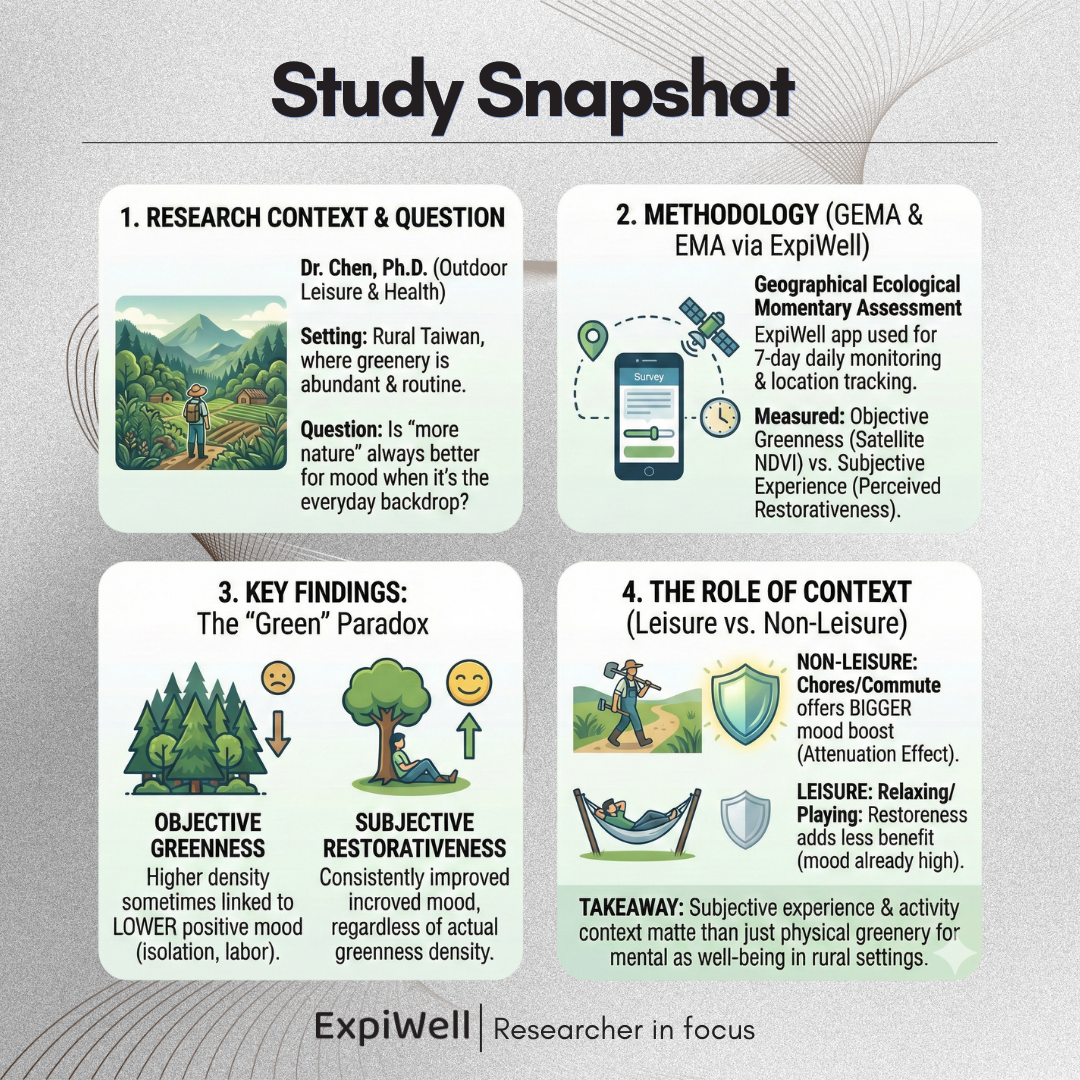
A central feature of the study was the team's distinction between "objective greenness" and "subjective experience."
This is where the results were surprising. While one might expect that areas with higher vegetation density (according to the satellite) would make people happier, Dr. Chen found the opposite in some cases. At a moment-to-moment level within the same person, higher satellite-measured greenness was sometimes associated with lower positive moods and higher negative moods.
Why? The researchers suggest that dense greenery in a rural setting might be associated with isolation, hard agricultural labor, or untended wilderness rather than a manicured park.
Conversely, perceived restorativeness was the real winner. Regardless of what the satellite said, if a person felt their environment was restorative, they consistently reported better moods. This finding is crucial: satellite maps cannot tell us how an environment is actually experienced on the ground.
Dr. Chen’s background in Outdoor Leisure was pivotal in analyzing what participants were actually doing in these spaces.
The team discovered an interesting pattern regarding the "attenuation effect." The beneficial link between feeling restored and having lower negative emotions was stronger when people were not engaged in leisure.
Think of it this way: If you are already relaxing outdoors and having fun, your "negative affect" is likely already low. Being in an environment that feels restorative doesn't add much more benefit. But, if you are doing chores or commuting (non-leisure), being in a space that feels restorative gives you a much bigger protective boost against bad moods.
Capturing these momentary fluctuations requires a sophisticated methodology. Leveraging his expertise in Geographical Ecological Momentary Assessment (GEMA), Dr. Chen designed a rigorous protocol to ensure data completeness and accuracy.
To achieve this, the team combined platform-based monitoring with structured communication:
For a comprehensive overview of ExpiWell’s capabilities, visit this page: ExpiWell's Features
This hands-on approach allowed Dr. Chen’s team to shift attention from general differences between people to the momentary fluctuations within the same individual across different contexts.
Dr. Chen’s research highlights a vital nuance in the "nature heals" narrative. We must distinguish between the physical characteristics of an environment and how people subjectively experience it.
Especially in rural settings saturated with greenness, simply adding more trees isn't the answer to emotional well-being. Instead, the quality of the environment, how restorative it is perceived to be, and what people are doing within it are central to understanding how nature affects how we feel right now.
Dr. Chen's work is a powerful reminder that our environments and the durability of our thoughts are just as important as our willpower. We invite you to explore more about his findings and other impactful studies in our Journal Publications section.
Are you ready to discover the "why" behind your participants' behaviors in real-time? Reach out to us at sales@expiwell.com or Schedule a Demo right now and let’s discuss how our platform can support your next breakthrough.



.png)
