%20(2).png)
The journey through breast cancer does not end when treatment stops. For many, the transition into survivorship brings a new set of challenges: lasting physical symptoms, emotional distress, and the pressure of returning to "normal" life. Dr. Rosie Shrout, an Assistant Professor at the University of British Columbia and adjunct Assistant Professor at Purdue University, is dedicated to understanding how these challenges affect not just the survivor, but the couple as a unit.
“Breast cancer survivors and their partners often face increased risks for health problems due to the chronic stress of the cancer experience,” Dr. Shrout explains. “But their strong and satisfying relationships may help protect them. We wanted to see how their daily relationship interactions and stress contribute to long-term health.”
ExpiWell sat down with Dr. Shrout to discuss her recent study on couples in breast cancer survivorship and how Ecological Momentary Assessment (EMA) provided a vital window into their daily lives.
Dr. Shrout’s research focuses on the "we-ness" of cancer recovery. While much of the existing research looks at survivors in isolation, Dr. Shrout recognizes partners as "secondary survivors." These partners often experience significant emotional and physical stress from the potential loss of their loved one, which can increase their own morbidity and mortality risks.
The study aimed to examine how satisfying relationships act as a buffer against stress. By capturing real-time data, the research sought to identify the pathways through which daily relationship experiences translate into better long-term health outcomes for both individuals.
The primary motivation behind this work is the recognition that relationships are a powerful social determinant of health. In the context of cancer, reduced intimacy and relationship satisfaction are common side effects of treatment.
"Couples’ strong and satisfying relationships offer broad health benefits and can protect health during stress," says Dr. Shrout. "By screening for relational distress early, we can refer couples to counseling that not only enhances their bond but actively promotes their physical recovery across the survivorship period."
To understand the nuances of a relationship, you have to see it in action. Traditional retrospective surveys often suffer from recall bias—people tend to remember only the "peaks" or "valleys" of their week. To combat this, Dr. Shrout utilized Ecological Momentary Assessment (EMA) via the ExpiWell app.
Study Snapshot: Data & Participation
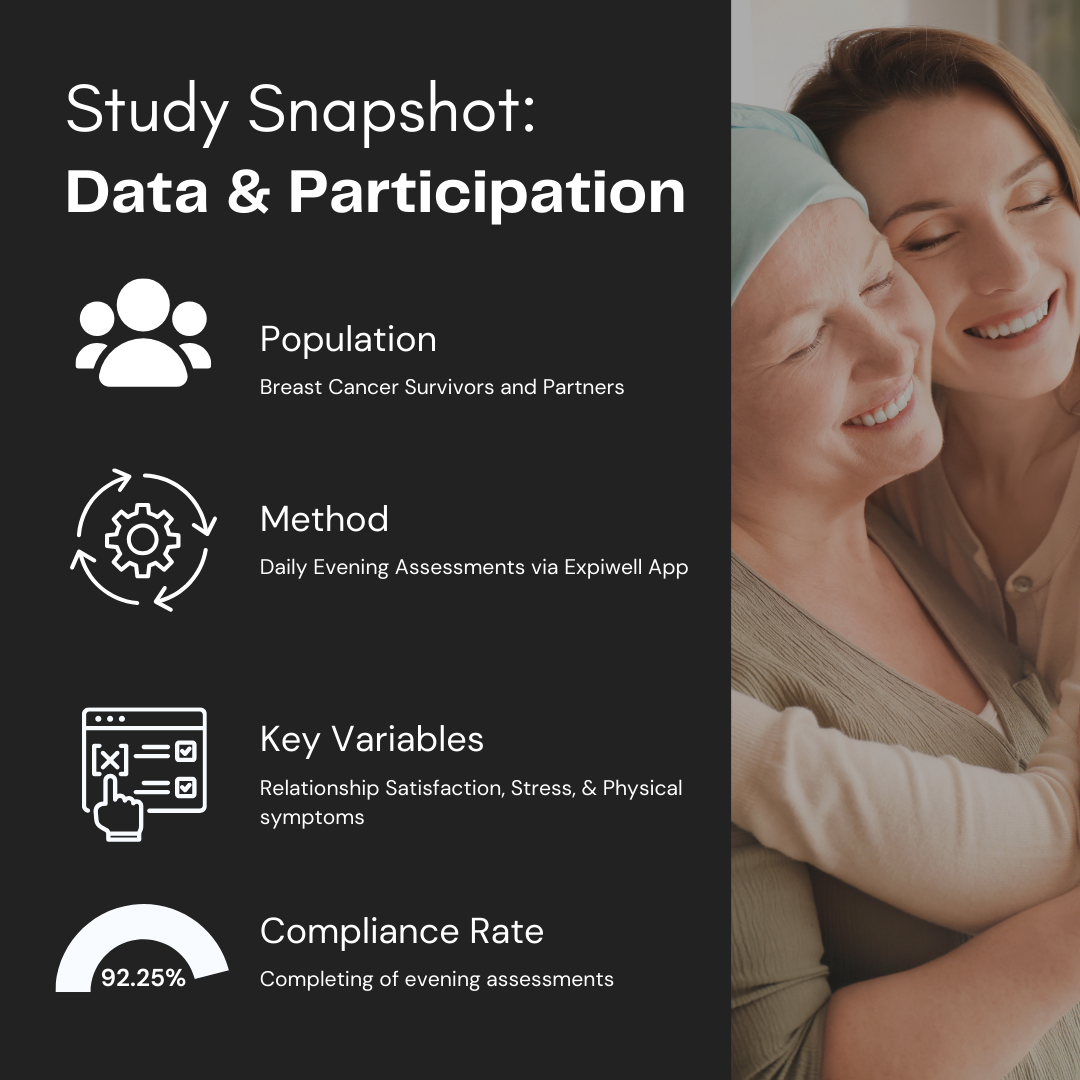
Dr. Shrout noted that the high response rate (over 92%) was a testament to the app's ease of use, even for older adults who might be less familiar with mobile health technology.
The findings from Dr. Shrout’s study provide compelling evidence for the protective power of a healthy partnership:
"Our methods offer a vital window into couples’ homes and daily interactions to demonstrate the stress and health benefits of couples’ relationships in everyday life." — Dr. M. Rosie Shrout
Dr. Shrout emphasizes that the success of a complex EMA study relies heavily on the tools used to collect data.
"ExpiWell is very user-friendly for both researchers and participants," she shares. "We have had a range of age groups successfully use the app, including both adolescents and older adults. The ability to create custom schedules and send automated notifications helped us keep our submission rates incredibly high."
For Dr. Shrout, the platform was more than just a data collection tool; it was a means to ensure the scientific integrity of her findings through "clean" and consistent data reporting.
The ExpiWell team is proud to support researchers like Dr. Shrout who are pushing the boundaries of health psychology and relationship science. Her work highlights the critical need to support the "unit" rather than just the individual.
In Case You Missed Our Other Spotlights:
Ready to start your own EMA study? Contact us at sales@expiwell.com or visit our website to learn how our platform can facilitate your next breakthrough.