Researcher in Focus: Shiva Pauer and his Team on the Temporal Dynamics of Human Decision-Making

Introduction: Mapping the Internal Tug-of-War
Meet Shiva Pauer, a dedicated behavioral scientist from Helmut Schmidt University Hamburg. Alongside colleagues Bastiaan T. Rutjens, Wilhelm Hofmann, and Frenk van Harreveld, Shiva Pauer and his team are peeling back the layers of human indecision. Their work focuses on the psychological "tug-of-war" we face daily, specifically researching how internal conflicts emerge, fluctuate, and eventually resolve in real-world settings. By utilizing a high-resolution process-tracing approach through Experience Sampling, Shiva Pauer and his team have mapped the temporal dynamics of how conflict evolves naturally.
The Motivation: Moving Beyond "Static Snapshots"
What motivates Shiva Pauer and his team to pursue this intensive line of research is a desire to move psychology beyond "static snapshots". Most psychological theories are built on laboratory experiments that strip away the complexity of real life.
Shiva Pauer and his team argue that because psychological processes like decision-making are inherently dynamic and sequential, they must be studied as they unfold. They were motivated to fill a critical gap in the literature: the lack of ecologically valid research on the temporal dynamics inherent to psychological experiences, which they believe hampers scientific progress.
The Study: A Deep Dive into the "Meat Paradox"
The study, titled "The Temporal Dynamics of Attitudinal Conflict in Daily Life: An Experience Sampling Study of Conflict Emergence and Resolution" is an intensive deep dive into what researchers call the "Meat Paradox". It investigates attitudinal conflict, the internal battle between the pleasure or cultural tradition of eating meat and simultaneous concerns regarding animal welfare, health, or sustainability.
The primary goal of the research was to move beyond the idea of conflict as a static state. Instead, the team set out to investigate the entire "decisional circle," mapping the precise temporal dynamics of how conflict surges before a choice is made and how it is regulated and resolved afterward.
The Method: Experience Sampling as the Engine of Discovery
The team chose the Experience Sampling method (ESM) as their primary tool for its high ecological validity.
- What is the Experience Sampling Method? It is an intensive longitudinal research methodology used to capture people’s momentary thoughts, feelings, and behaviors in their natural environments. It prioritizes "real-time" assessment over retrospective memory.
- How is it Usually Used? It is typically used to investigate "within-person" fluctuations in how an individual's state changes over time to test theories in everyday life.
- What Data Gathering Triggers are Used? Experience Sampling usually relies on three types of triggers:
- Signal-Contingent: Notifications at random time points.
- Event-Contingent: Reports triggered by a specific event, like a meal.
- Interval-Contingent: Reports at fixed time intervals.
How was Experience Sampling Implemented in this Study?
The team developed a creative way to map the temporal dynamics of human decision-making by combining two data sources: random "check-in" surveys and specific meal reports. By measuring the time between a random survey and the actual start of a meal, they could pinpoint exactly how internal conflict grows and fades as a decision approaches. This "integrated" process-tracing approach allowed them to create a high-resolution, step-by-step look at how people struggle with choices in their everyday lives.
The Process: Real-Time Smartphone Surveys
To capture these brief emotional shifts as they happened, the team used high-resolution process-tracing through smartphone surveys. This allowed them to track psychological states in the moment, avoiding the bias that occurs when people try to remember their feelings after the fact.
Expounding on Process-Tracing
In this research, process-tracing is the analytical engine. While traditional survey methods often focus on "what" a person chooses, process-tracing is dedicated to uncovering the "how" and "when" of the internal psychological journey.
By using Experience Sampling to perform process-tracing, the team were able to observe the sequential interplay of various regulatory processes as they occurred in real-time. For academic researchers, this approach is transformative because:
- It Maps the Decisional Circle: Rather than treating a choice as an isolated data point, process-tracing follows the trajectory of a psychological state, such as moving from a rise in conflict to the eventual use of a resolution strategy like denial of responsibility.
- It Captures Fleeting "Hot Phases": Human emotions can be transient. Process-tracing ensures that the "hot phase" of behavioral enactment (such as the onset of a meal) is not missed or smoothed over by memory.
- It Tests Sequential Interplay: the team used this method to test whether people engage in a "cascade" of resolution attempts over time.
This allowed the team to trace decision-related experiences as they occurred, rather than asking participants to reconstruct feelings later through a lens of rationalization.
The data gathering procedure included:
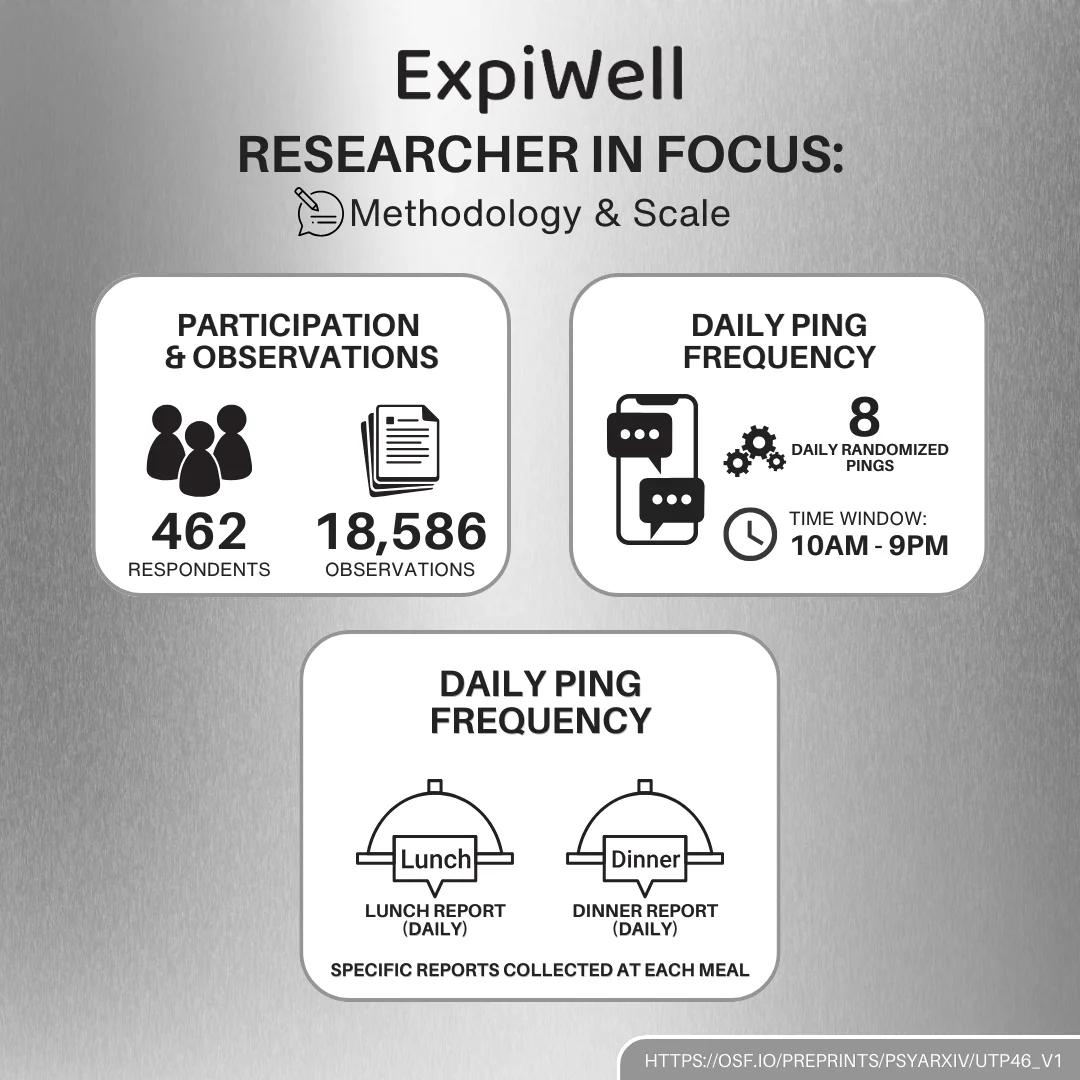
- Large-Scale Participation: Gathering a total of 18,586 observations from 462 participants.
- High-Frequency Pings: Participants completed eight randomized "signal-contingent" surveys daily between 10 am and 9 pm.
- Event-Based Reports: Participants provided specific reports at each lunch and dinner.
- Intensive Density: This hybrid method created a dataset with a median of 36 observations per minute surrounding meal times.
Using the ExpiWell app, Shiva Pauer made this complex procedure easy for participants, resulting in an excellent completion rate of 80.5%.
Challenges and Solutions: Navigating the Real World
A major challenge was that the temporal dynamics of psychological states are often underspecified and untested in naturalistic settings. Laboratory settings can produce different dynamics than real life because real life offers more flexibility in switching between different coping strategies.
To ensure the highest standards of scientific rigor, Shiva Pauer moved the study directly to the participants' smartphones. This transition allowed them to implement strict data quality controls, such as including attention checks and excluding any surveys completed with a median speed of less than one second per item. Most importantly, utilizing Experience Sampling mitigated the pervasive challenge of recall bias, which often leads participants to rationalize their choices when looking back.
Reflecting on the success of this approach, Shiva Pauer noted that while these checks were essential for the study's preregistered quality standards, the data quality provided by the ExpiWell platform was exceptionally high surpassing what is typically seen in traditional survey formats. This high level of engagement ensured that the process-tracing of temporal dynamics remained accurate and reliable throughout the five-day mobile phase. By capturing these "right now" reflections, Shiva Pauer team were able to observe the psychological journey of a decision without it being distorted by the human tendency to rewrite history to avoid guilt.
Surprising Findings: The 36-Minute Peak
The temporal dynamics uncovered by Shiva Pauer team revealed a systematic "countdown" to decision-making:
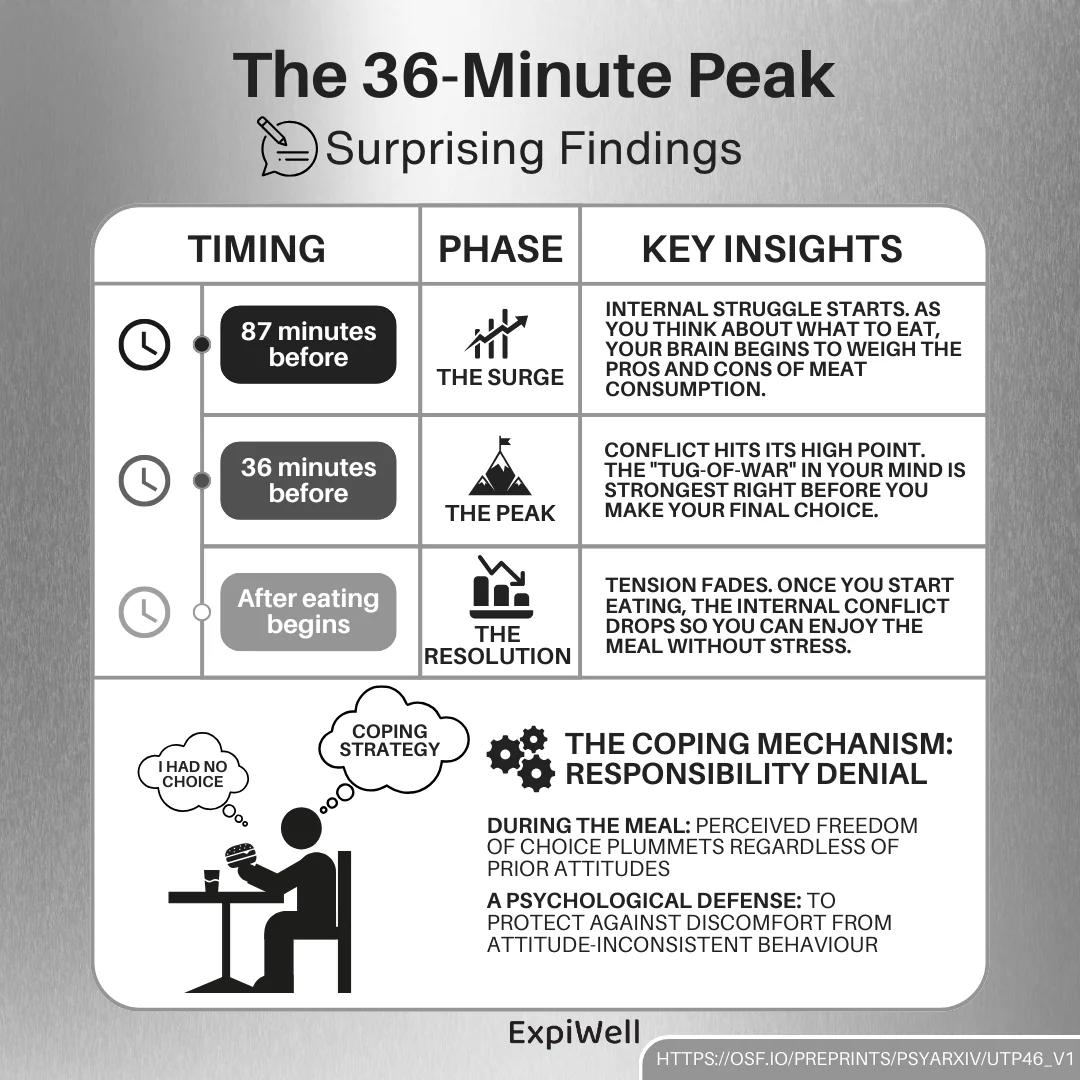
- The Surge: Conflict begins to surge significantly 87 minutes before a meal.
- The Peak: Internal conflict hits its highest point exactly 36 minutes before the meal.
- The Resolution: Conflict drops significantly after eating begins.
- Responsibility Denial: During the meal, participants' perceived freedom of choice plummeted, regardless of their prior attitudes. Shiva Pauer team suggest this is a coping mechanism, a denial of responsibility to protect against discomfort during attitude-inconsistent behavior.
Platform: Making Research Possible
This high-resolution process-tracing was made possible through the ExpiWell platform. To manage nearly 19,000 observations, Shiva Pauer team needed a tool that was robust and reliable for intensive longitudinal data.
ExpiWell made data gathering easy and smooth by providing:
- Flexible Logic: Allowing for the integration of randomized "pings" and meal-triggered reports.
- Mobile Accessibility: Supporting both Android and iOS so participants could respond in naturalistic settings.
- Reliability: Ensuring precise recording of survey completion times, which was essential for calculating the temporal dynamics of the decision-making process.
Invitation to the Research Community
The work of Shiva Pauer team demonstrates that the temporal dynamics of conflict provide a clear "opportunity window" for behavior change. By identifying exactly when conflict is highest, we can time interventions, such as healthy recipe suggestions, to be much more effective.
We invite the research community to adopt this integrated Experience Sampling and process-tracing approach. By catching the "right now" through the power of Experience Sampling, we can advance our understanding of the psychological dynamics that unfold in everyday life.
Ready to modernize your research? Explore how ExpiWell can transform your next study into a professional, compliant, and deeply engaging experience.
for inquiries send an email at sales@expiwell.com or schedule a demo